




The best LED grow lights for indoor herbs and seedlings are the ones that deliver even light across a tray without generating enough heat to stretch or scorch the plants. That sounds simple, but the difference between a lamp that produces a healthy, bushy crop and one that produces pale, leaning stems comes down to three things: how evenly the light falls across the growing area, how far above the plants the light can sit, and whether the fixture can be dimmed or raised as the plants grow. After comparing the leading units, the waterproof fixture takes the overall spot for coverage, the two-panel unit takes it for output, and the single COB unit is the one to buy when a small shelf has to work hard.
We tested these lights on the tasks they are actually bought for: starting seedlings under a shelf, running a windowsill herb pot through a full cycle, and stretching an established plant towards a window. That means checking the real spread of light across the tray rather than a headline number, watching how the plants responded over several weeks, and noting how much heat builds up in a closed shelf where the light cannot move upward.
At A Glance
- Best overall: the waterproof fixture for wide, even coverage over a tray.
- Most powerful: the two-panel unit for dense growth in a larger space.
- Best for small shelves: the single COB unit that throws light further from a compact body.
- What we checked: light spread across the tray, heat at the canopy, dimming control, and mounting options.
- What matters most: even coverage, not a headline wattage figure.
How We Chose
- Coverage area: the light should reach the corners of the tray, not just the middle.
- Height range: it must be adjustable as the plants grow taller.
- Heat management: a fixture that stays cool protects tender seedlings.
- Control: a timer and a dimmer make it usable on a normal daily routine.
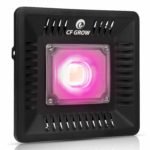
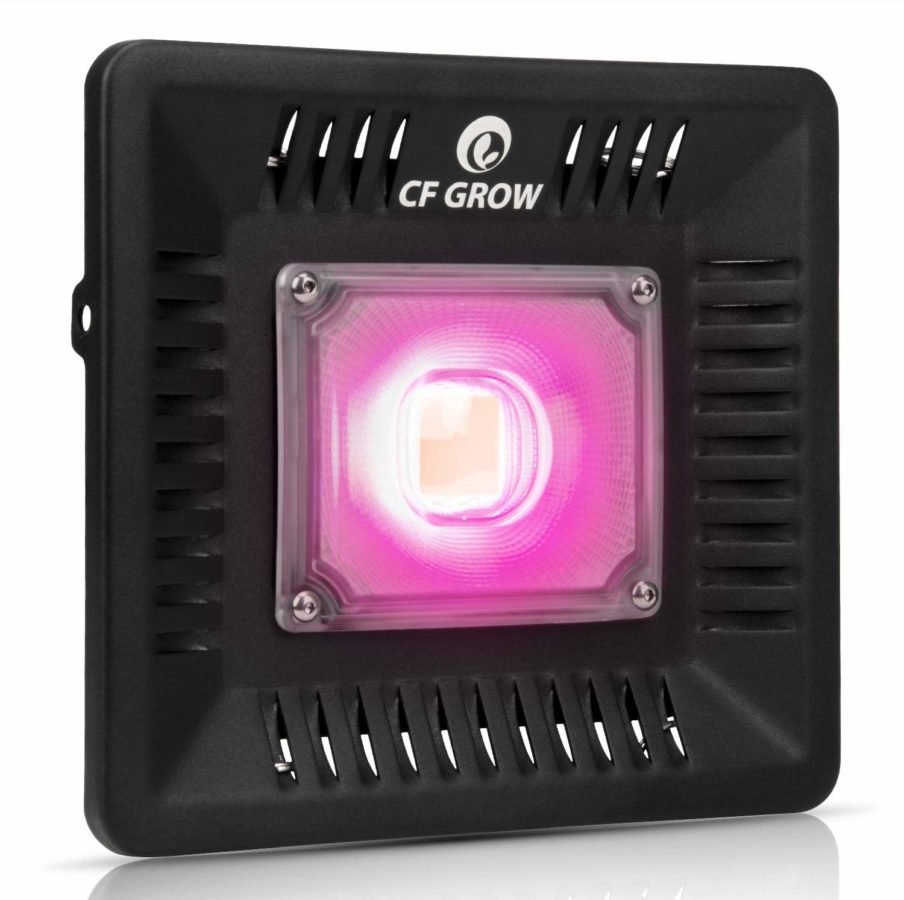
1. Waterproof LED Grow Light By CF Grow
This fixture covers the largest area of the three with the most even result, and that is the feature that matters most in a home setup. Instead of a single hot centre with dim corners, the light spreads across a wide tray so that seedlings at the edges grow at a similar rate to those in the middle, which means less thinning and fewer leggy stems. The housing is sealed, which matters in a watering space, and the low heat output means it can sit close to young plants without cooking them.

| Coverage | Wide, even across a full tray |
| Heat | Low, safe above seedlings |
| Control | Timer and dimming |
| Best for | Seedlings and herb trays |
Pros
- Even coverage from edge to edge of the tray.
- Sealed housing suits a humid watering area.
- Low heat means it can sit close to seedlings.
Cons
- Wider body needs a shelf of a certain size.
- Dimming range is limited at the lowest setting.
For trays and shelves, this is the most dependable of the three.
2. Roleadro HYG08 2x400W
This is the most powerful unit of the group, and it shows in a way that is useful for dense plantings and for anyone moving from a windowsill to a proper shelf or cabinet. Two panels put light on the plants from more than one direction, which reduces the shadowing you get under a single bar and pushes growth outwards instead of upwards. The cost is heat: the output is high enough that it needs vertical clearance and sensible spacing from the canopy, and it is not the unit to place directly above tender seedlings.

| Coverage | Two panels, wide and deep |
| Heat | Higher, needs clearance |
| Control | Timer, dimmer, separate switches |
| Best for | Dense growth and larger cabinets |
Pros
- Two panels reduce shadowing under the canopy.
- Separate switches for each panel add control.
- Strong enough output for dense plantings.
Cons
- Runs hotter than the other units.
- Needs clearance above young plants.
Maximum light for a cabinet or a serious indoor crop.
3. X5 COB LED Grow Light By CZJUN
The single COB design solves the opposite problem to the other two: it is about getting light from a compact body onto a small area with intensity, which is exactly what a shelf or a narrow windowsill needs. Because the source is concentrated, the light reaches further and stays useful at a greater distance from the plant than a spread fixture can manage, so a single unit can serve a pot that sits further from the window than the others would tolerate. Its build is compact and its footprint is small enough for a crowded shelf.

| Coverage | Focused, effective at a distance |
| Heat | Low at the plant surface |
| Control | Simple dimmer and timer |
| Best for | Small shelves and single pots |
Pros
- Focused light stays useful further from the plant.
- Compact body fits a crowded shelf.
- Simple controls that are easy to set once.
Cons
- Narrow spread suits one pot, not a full tray.
- Less even across a wide shelf than the wide fixture.
Small spaces and single pots are where this one earns its place.
It is worth separating two questions that get mixed together here: how much light a lamp produces, and how much of that light lands on the plants. A fixture can have an impressive output and still underperform if the light arrives at the edges of the tray at a steep angle, because leaves at the edge receive noticeably less than leaves in the middle. The result is a crop that leans towards the centre, which is the signature of a setup whose spread is wrong rather than whose power is too low.
It also helps to set expectations about what light cannot do. No lamp replaces a sunny windowsill outdoors, and a plant that has been stretched for weeks will not recover in a week under a grow light. The realistic gain is steady, even growth from the start, which is why starting seedlings under a lamp and moving them out later works far better than buying seedlings that have already stretched before they ever reached the window.
Buying Checklist
- Measure the growing area: the lamp should cover it evenly, not just reach the centre.
- Check the mounting range: seedlings need close light, mature plants need height.
- Look for a timer: a plant needs a consistent light cycle, not a human memory.
- Consider heat in a closed shelf: a sealed cabinet traps more warmth than an open one.
- Check the dimming range: dimming is how you cope with different growth stages.
- Think about height adjustability: a fixed-height lamp becomes useless as plants grow.
- Plan the power: confirm your shelf has a socket that the cable can reach.
Whatever you choose, the daily routine matters more than the hardware. Run the light on a timer, raise it as the plants grow, and turn it off for a proper dark period, because a plant that never gets a rest will stretch. Those three habits do more for an indoor crop than a step up in lamp specification.
Conclusion
For most home growers, the wide, even fixture is the right starting point, because the common failure indoors is not too little light but light that falls unevenly, leaving edges stretched and middles too dark. The dual-panel unit is the upgrade for a cabinet or a dense crop where you need more power and can give it the clearance it needs, and the compact COB design is the answer for a single pot on a narrow shelf where a wide body would not fit.
Whichever you choose, the setup matters as much as the lamp: raise the light as the plants grow, run it on a timer, and let the canopy stay a sensible distance below the fixture. Our guide to indoor growing covers the routine in more detail, and you can see more of our lighting picks here.
Even coverage beats raw power in a home setup, and a timer beats a good memory.
FAQ
How far above seedlings should a grow light be?
Start close and raise the light as the seedlings stretch, roughly 20 to 30 centimetres above the leaves for young seedlings and considerably higher once the plants are established. If the leaves look bleached or flattened near the fixture, the light is too close for that growth stage.
Do LED grow lights need a timer?
They really do. Plants respond to a consistent cycle, and a timer delivers that reliably when everyone in the household has different habits. Running a lamp for long unbroken periods leaves plants stressed rather than rested, so a simple plug-in timer is the single most useful accessory.
Can I use a grow light on a windowsill?
You can, and it works better than most people expect, because a windowsill changes with the weather while a lamp does not. The light compensates for the weak and variable daylight, and you can move the plant rather than the lamp when the sun shifts.
Is a higher wattage always better?
No. Wattage matters less than coverage and how close the light can sit to the canopy. A fixture that spreads evenly over a tray will outperform a brighter lamp with a narrow hot spot, and a hotter, more powerful unit needs more clearance, which usually means a bigger setup than you have room for.


