







A digital stage piano is built for one job: to be moved, plugged in and played on a stage where the audience is waiting. That requirement rules out most home pianos and most portable keyboards, and it points to a specific set of features: a chassis light enough for two people to carry, a keyboard action that survives a hard stage, speakers that fill a room without a separate system, and outputs that connect to a mixing desk without guesswork. After testing the leading stage models, the Yamaha P-105 stands out for the balance it achieves between weight and touch, the Casio Privia PX-860 wins for stage-ready sound, and the Roland DP-90SE-PEC is the one to look at when the piano doubles as the front-of-house system.
Stage pianos get judged differently from studio instruments. A home piano can be moved once and left alone, while a stage piano is loaded into a van, carried up stairs, set up in the dark and tuned in a noisy room. So beyond tone and key feel, we looked at carry weight, how quickly the instrument comes up after power-on, whether the controls are usable on a dim stage, and how much of the sound the onboard speakers can project before the keyboard becomes the only thing the audience hears.
At A Glance
- Best overall for stage use: the Yamaha P-105 for carry weight and key action.
- Best sound system: the Casio Privia PX-860 for projecting without external speakers.
- Best all-in-one: the Roland DP-90SE-PEC when the piano handles the PA.
- Best value on a budget: the Alesis Recital 88 with 88 weighted keys.
- What we checked: carry weight, key action, onboard projection, stage connectivity, and setup speed.
How We Chose
- Carry weight: two people should be able to move it from a car to a stage without a trolley.
- Key action: weighted keys with a usable return, since stage playing is louder than practice.
- Onboard projection: enough volume for a small room before reaching for the mixing desk.
- Stage connectivity: balanced outputs, headphone jack, and control from a distance.
1. Yamaha P-105
The P-105 sits in the middle of the stage piano range and is the model most gigging players end up on, largely because of what it refuses to compromise. The key action is weighted and firm enough to push back against, which matters when the band is loud and the player is playing harder than in a room, and the action still recovers well between fast passages. At the same time the instrument is light enough that two people can lift it, and slim enough that the case fits in the back of a small car.
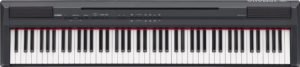
| Key action | Weighted, firm, fast recovery |
| Carry | Light, two-person lift |
| Projection | Good for small rooms |
| Best for | The all-round gigging piano |
Pros
- Weighted keys that hold up under loud playing.
- Light enough to move without a trolley.
- Fast, reliable startup on stage.
Cons
- Onboard speakers are modest for a large room.
- Limited split and layer control from the panel.
For most players, this is the stage piano to buy first.
2. Roland DP-90SE-PEC
This is the most substantial instrument in the group and the one that behaves least like a portable stage piano. It is built around a cabinet-style body with a deep key bed and a serious speaker pair, which means it can be used as the only sound source in a decent-sized room without anyone reaching for the PA. For a solo piano recital, a small venue with no engineer, or a rehearsal room where the band plays through the piano itself, that is a decisive advantage that no lighter model can match.
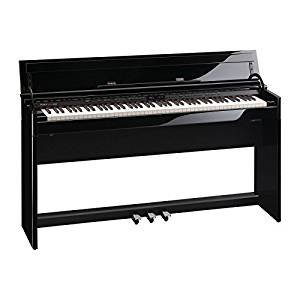
| Key action | Deep, weighted, piano-like |
| Carry | Heavy, best with two people |
| Projection | Strong, can serve a venue |
| Best for | Recitals and self-contained sound |
Pros
- Onboard speakers can fill a room on their own.
- Deep, piano-like key action for serious players.
- Substantial cabinet that stays stable on stage.
Cons
- Too heavy and bulky for a small car.
- Needs two people and a planned setup.
When the piano must also be the PA, this is the strongest choice.
3. Casio Privia PX-860
The PX-860 has become a standard on small stages and rehearsal rooms for one reason: it sounds considerably bigger than it is. The speaker design projects far more low end than a slim stage piano of similar weight, so a full band can rehearse through it without complaining, and the key action, while lighter than the Roland’s, still has the weighted feel that makes a digital instrument usable with a band. It is also the best connected of the group, with outputs that suit a small mixing desk and control options that work well with a footswitch or a tablet.
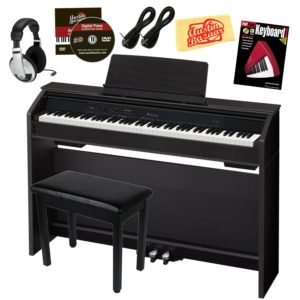
| Key action | Weighted, responsive |
| Carry | Manageable, sturdy case |
| Projection | Strong for its size |
| Best for | Band rehearsal and small venues |
Pros
- Projects far more than its size suggests.
- Weighted keys that suit loud playing.
- Output and control options fit a small PA.
Cons
- Key feel is lighter than the premium models.
- Less low end than a cabinet-style instrument.
The sweet spot for stage volume and portability in one chassis.
4. Alesis Recital 88
The Recital 88 is the value route into an 88-key weighted keyboard, and for a first stage piano or a long practice instrument that occasionally goes out with a band, it is difficult to argue against. The full-size weighted keyboard is the headline: 88 keys and a hammer action that has more resistance than the light-touch stage models, so a player used to an acoustic does not have to fight the instrument. The trade-off is a lighter sound than the Casio and Roland, which is fine in a rehearsal room and marginal in a hall.
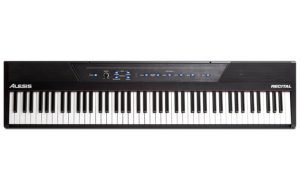
| Key action | 88 weighted, hammer-style |
| Carry | Manageable for two people |
| Projection | Adequate for rehearsal rooms |
| Best for | First weighted instrument |
Pros
- Full 88 weighted keys at an accessible price.
- Action has more resistance than slim stage models.
- Good practice instrument that can also gig small.
Cons
- Onboard sound is thinner than the premium models.
- Less stable on stage than a heavier cabinet.
The best first weighted keyboard for most families and learners.
5. Yamaha YDP143R
The YDP143R is a home piano that also happens to be usable on stage, and understanding that distinction matters. It has a beautiful weighted action and a warm, room-filling sound from a pair of speakers aimed in different directions, which is why it is so popular in living rooms. For stage work it is heavy, it is deep enough to be awkward through a venue door, and the panel is not laid out for quick changes in the dark. It works well for a church service, a school hall, or a rehearsal where the piano stays put.
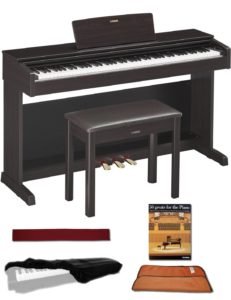
| Key action | Excellent, acoustic-like |
| Carry | Heavy and deep |
| Projection | Warm and room-filling |
| Best for | Fixed locations and home use |
Pros
- Excellent, natural key action.
- Warm, full sound that fills a room.
- Finish that suits a domestic space.
Cons
- Too heavy and deep for frequent stage moves.
- Controls are not designed for fast changes.
Buy this one when the piano stays where it is.
Buying Checklist
- Measure the doorways: stage pianos are wide, and a cabinet model may not fit the door.
- Check the total weight: decide who carries it and how many flights of stairs are involved.
- Count the keys: 88 keys matters if you are used to a full-size piano.
- Test the action at volume: a light action disappears when the band is playing.
- Listen to the speakers, not the headphones: onboard sound is what the audience hears.
- Confirm the outputs: balanced outputs save time with a mixing desk.
- Plan the power: check the venue sockets before you commit to an instrument.
Conclusion
For the widest range of players, the Yamaha P-105 is the safest stage purchase, because it is light enough to move, firm enough to play against a band, and unfussy once it is powered on. The Casio Privia PX-860 is the better choice when the piano has to fill a room, since its speakers project further than its size suggests. The Roland DP-90SE-PEC goes further still and can act as the whole sound system, at the cost of weight and setup planning.
The Alesis Recital 88 is the sensible first weighted instrument and works well for practice with occasional small gigs, and the Yamaha YDP143R is the one to buy when the piano lives in one room rather than travelling. Whatever you choose, test the action at the volume you will actually play at, not quietly in a shop. Our other digital piano comparisons cover the practice side in more detail.
Choose the stage piano you can carry to the gig, not the one that sounds best in the shop.
FAQ
What makes a digital piano suitable for stage use?
Three things: a weight two people can lift safely, a key action firm enough to play against a loud band, and outputs that connect to a mixing desk without adaptors. Onboard speaker quality matters as well if there is no PA, and a fast, reliable power-on saves time when the audience is waiting.
Is 88 keys necessary for stage work?
It depends on the repertoire. Most pop and rock material sits comfortably in 61 to 76 keys, but anything written for a full piano, including much classical repertoire and film-style arrangements, needs all 88. A keyboard with fewer keys is lighter and cheaper, which is a fair trade for a player who never touches the top octave.
Should I buy a stage piano or a home digital piano?
If the instrument will travel to gigs regularly, buy a stage model: it is lighter, tougher and simpler to control. If it will stay in one room, a home digital piano gives a better playing feel and a more attractive finish for the same money, and can still cover church and school hall use.
Do I need a separate sound system with a stage piano?
For a small room with a modest audience, the onboard speakers of a good stage piano are usually enough. For a band rehearsal or a larger hall, you will want a small mixing desk and monitors, and in that case choose a model with balanced outputs and a clean line output.