







The best floor lamps for a room are the ones that match three things: the size of the space, the height of the seat they sit next to, and the kind of light the room needs after dark. After comparing the standing lamps on test, a tall adjustable-arm lamp suits a bright living room best, a slim daylight lamp works when you read at a low side table, and a pharmacy-style shade is the one to pick when the light has to be directed rather than scattered.
Floor lamps are often bought as a quick fix for a dark corner and then left switched on for six hours a day, which makes the difference between a lamp that glares and a lamp that reads well surprisingly important. We looked at brightness spread, reach, how a lamp handles a tall or low seating area, and how much heat and power draw each design puts into a room.
At A Glance
- Best for a large room: the tall adjustable-arm lamp, which throws light well past a sofa.
- Best for reading: the slim daylight lamp with a wide, even spread at a side table.
- Best directional light: the pharmacy style, whose shade can be aimed at a chair.
- Best value for a small room: the compact brushed-nickel lamp, which takes up almost no floor space.
- What we checked: reach, spread of light, heat at the shade, and stability on thin pile.
How We Chose
- Reach and height: the shade should sit near head height when seated, or the light lands on the floor instead of the page.
- Spread versus glare: a wide, diffused spread reads better than a narrow hot spot.
- Adjustability: an adjustable arm or tilt head beats a fixed shade in almost every room.
- Footprint and base: a narrow base saves space, but a wide weighted base stops a tall lamp tipping on thick carpet.
1. Best Floor Lamps For Bright Light
Brightness in a floor lamp comes from two separate things: how much light the source produces, and how much of that light the shade lets through. The strongest general-purpose option here does both well. Its reflector is sized for a room rather than a bedside table, so light spreads across a seating area rather than pooling in one spot, and the whole head can be swung toward the darker side of a room when you want to read.

| Light spread | Wide, room-filling |
| Adjustability | Swivelling head, adjustable height |
| Best room | Living room, open-plan space |
| Footprint | Wide weighted base |
Pros
- Illuminates a whole seating area rather than one corner.
- Head can be aimed toward a dark wall or a book.
- Weighted base keeps it steady on deep carpet.
Cons
- The wide shade needs clearance from low ceilings.
- Bigger footprint than a slim lamp.
For a room that needs to feel lit rather than spot-lit, this is the strongest choice.
2. V-Light Natural Daylight Floor Lamp
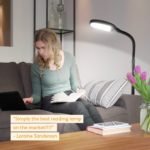
The lamps most people picture as a floor lamp are really tall versions of a desk lamp, and that is exactly what this one is. The tall, narrow shade is engineered to spread a bright, even pool over a side table or an armchair, and the daylight-leaning output keeps colours in a room looking true in the evening rather than the amber wash that halogen bulbs produce. It is the lamp to use when the evening job is reading rather than lighting a whole room.

| Light spread | Even, medium pool |
| Adjustability | Tilt head, tall stem |
| Best room | Bedroom or reading corner |
| Footprint | Narrow base |
Pros
- Even, colour-accurate light that makes reading easier at night.
- Tall stem puts the light near seated eye level.
- Narrow base suits a tight corner beside a sofa.
Cons
- Not bright enough to light a large room on its own.
- The head does not swing far, so it covers one spot only.
Choose this when the lamp’s job is reading light rather than room light.
3. V-Light Pharmacy Style
The pharmacy style is the classic adjustable lamp shape: a deep conical shade on a jointed arm that can be angled precisely at a chair, a desk, or a page. In a room where the light needs to be controlled rather than spread, that articulation is the whole point. Aimed low, the shade hides the bulb from the room and reduces the glare that makes a bare bulb tiring, which is why this style has survived in hospitals and reading rooms for a century.

| Light spread | Focused, fully directional |
| Adjustability | Multi-joint arm, tilt shade |
| Best room | Reading chair, home office |
| Footprint | Medium base |
Pros
- Light can be aimed precisely where the task is.
- Deep shade hides the bulb and cuts glare for the reader.
- Arm holds its position without drifting.
Cons
- Focused light leaves the rest of the room dark.
- The joints need occasional tightening over the years.
For one specific chair and one specific task, this is the most precise tool here.
4. V-Light Ultra Slim
Where floor lamps usually lose is floor space, and this design attacks that directly. The stem is narrow enough to stand in the gap between a sofa arm and a wall without anyone tripping over it, while the shade still spreads a usable pool over a seat. For a small flat, a rented room, or an awkward corner where a conventional base would not fit, that slim profile is worth more than raw brightness.

| Light spread | Medium, well directed |
| Adjustability | Tilt head on a slim stem |
| Best room | Small spaces and tight corners |
| Footprint | Very narrow |
Pros
- Fits into gaps where a normal base would block a walkway.
- Visually light in a small room.
- Head still tilts to correct the angle of a seat.
Cons
- A narrow base is easier to tip than a wide one.
- Output is modest compared with the large reflector.
Small rooms make this the sensible first choice.
5. V-Light Halogen Lamp With Adjustable Arm
This lamp pairs that output with an articulated arm, so the light can be brought down over a table or pulled back to wash a wall. The practical consideration is heat: the shade should have some air movement around it, and it is better positioned where nobody leans into it. Within that constraint, the reach of the arm makes it unusually flexible for a single lamp.

| Light spread | Bright, focused beam |
| Adjustability | Long adjustable arm |
| Best room | Dining area, craft table |
| Footprint | Medium base, long reach |
Pros
- Long reach pulls light over a table or a worktop.
- Warm output suits dining rooms and evening rooms.
- Simple, mechanical adjustment that holds position.
Cons
- Runs hotter near the shade than LED alternatives.
- Halogen bulbs cost more to replace over time.
Good reach and warmth make this a strong pick for a dining table.
6. V-Light Adjustable Desk Lamp With Brushed Nickel
The brushed nickel finish gives this design the least intrusive look of the group, and it reads as furniture rather than equipment. It is a compact lamp with a short stem and a tilt head, so it works as a floor lamp beside a low chair, or as a task lamp on a tall console. It is the choice when the lamp has to disappear into the room, not compete with it.

| Light spread | Medium, controlled |
| Adjustability | Tilt head, compact stem |
| Best room | Living room, hallway console |
| Footprint | Compact |
Pros
- Neutral, understated finish that suits modern interiors.
- Fingerprint-resistant surface stays presentable.
- Compact enough to double as a console lamp.
Cons
- Smaller shade means a narrower pool of light.
- Short stem limits how high it can be adjusted.
When looks matter as much as output, this is the one that blends in.
Buying Checklist
- Measure the space first: note the ceiling height and where the lamp can stand without blocking a walkway.
- Decide between task light and room light: a narrow spread reads better; a wide reflector lights more space.
- Check the maximum reach: the shade should be able to sit near seated head height.
- Look for a tilt or swivel joint: fixed shades rarely end up where you need them.
- Confirm the base width against your carpet: a narrow base needs a flat, firm surface.
- Think about heat at the shade: warm bulbs run hotter and need clearance.
- Match the finish to the room: brushed metal reads as furniture, painted metal as equipment.
Conclusion
Start by deciding what the lamp is for. If the job is a reading chair in the corner, the slim daylight lamp gives an even pool at seated height without lighting the whole room, and the pharmacy style is better still when the light must be aimed exactly at a page.
Smaller spaces argue for the ultra slim or the brushed nickel compact, both of which trade a little output for a footprint that does not dominate the room. Whichever you choose, the details that decide satisfaction are the ones that only show up in a real room: how the light lands, how much the shade hides the bulb, and whether the lamp ends up where the armchair actually is. Read more of our best table lamp and lighting picks here.
FAQ
Which type of floor lamp is best for a living room?
For a living room that needs general light, a wide reflector head that can be swivelled is the most effective, because it covers a seating area and can still be aimed at a dark corner. A narrow task lamp only lights the area around it and leaves the rest of the room dim.
Do I need a dimmer switch for a floor lamp?
A dimmer makes a lamp usable for more of the evening, because most lamps are too bright at full output for reading and too dim as the only light in a room. If the lamp has a separate on and off switch only, an inline dimmer is a straightforward addition.
How high should a floor lamp be above a sofa?
The bottom of the shade should sit roughly level with, or slightly above, the head of someone sitting in the sofa. Any higher and the light lands on the top of the cushion instead of the lap and the pages.
Are halogen floor lamps still worth buying?
Halogen bulbs give warm, punchy light that many people prefer in the evening, but they run hotter and cost more to replace than LED bulbs. For most rooms an LED alternative covers the same jobs with less heat and lower running cost.